QR scans
Every card carries a code unique to that house. Scans report per campaign with scan rate and unique-scan counts.
- One code per home, not per campaign
- Scan rate and unique scans, split out
PRODUCT · PROOF
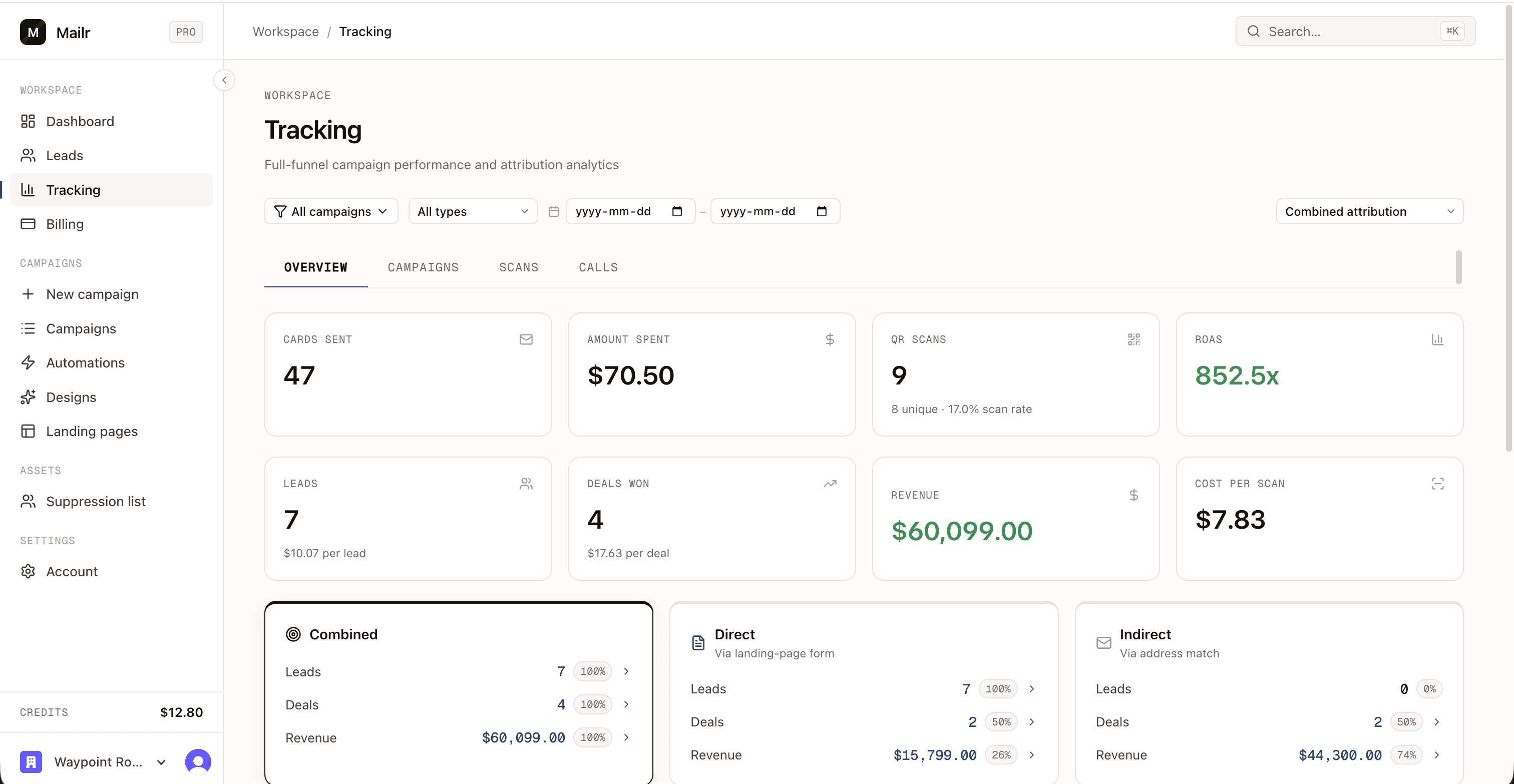
Three capture channels, reported separately — scans, calls, and the ones who Google you instead.
THE CHAIN
Most direct mail ends at “we sent 500 cards.” Mailr keeps following the piece after it leaves the truck.
It carries a QR code that belongs to that house and nobody else's.
Three ways a homeowner answers a mailer. Mailr catches all three, separately.
The landing page frozen for that address — before & after, offer, form.
Source-labeled Mailr, deduped, deep-linked both directions.
Revenue syncs back and lands against the campaign that caused it.
THE MODEL, IN FOUR NUMBERS
capture channels, reported separately
scans · calls · searchIn the productaddress-match radius on closed deals
credit lands on the exact mailed homeIn the productretro-match window for calls
catches calls that beat the CRM recordCallRail integrationday attribution window, your call
per CRM connection · default 180In the productTHREE WAYS THEY ANSWER
Every card carries a code unique to that house. Scans report per campaign with scan rate and unique-scan counts.
CallRail integration: designate your direct-mail numbers or dedicate a number to one campaign. Answered, missed, voicemail, and duration — and calls ladder up to leads and revenue, including a 60-day retro-match for calls that arrive before the contact exists in your CRM.
Most homeowners don’t scan; they search. Closed deals in your CRM are geocoded and matched to the exact mailed home within 30 meters, so mail gets credit even when nobody scans.
REVENUE
Every campaign reports the whole funnel, not just what left the building — with drill-downs to individual deals, leads, and calls, each one deep-linked back to the record in your CRM.
REPORTED PER CAMPAIGN
Came through the card’s landing page form.
The strictest read there is. Nothing inferred, nothing matched — they held the card and filled in the form.
For the skepticsMatched by address.
Scans, CRM-synced leads, and closed deals tied back to a home you actually mailed — the response that never touched a form.
The quiet majorityBoth, in one view.
A dashboard toggle, not a setting you argue about. Skeptics run Direct, believers run Combined, and the underlying records never change.
The default toggleTHE FINE PRINT, IN PLAIN SIGHT
The attribution window is adjustable from 1 to 365 days per CRM connection (default 180) — credit mail for 30 days or a full year, your call.
THE PART WHERE YOU START
Connect your CRM, pick a neighborhood, and put a 1-of-1 card in every mailbox that matters. First campaign out the door in an afternoon.
No contracts · No minimums · $1.30 a card